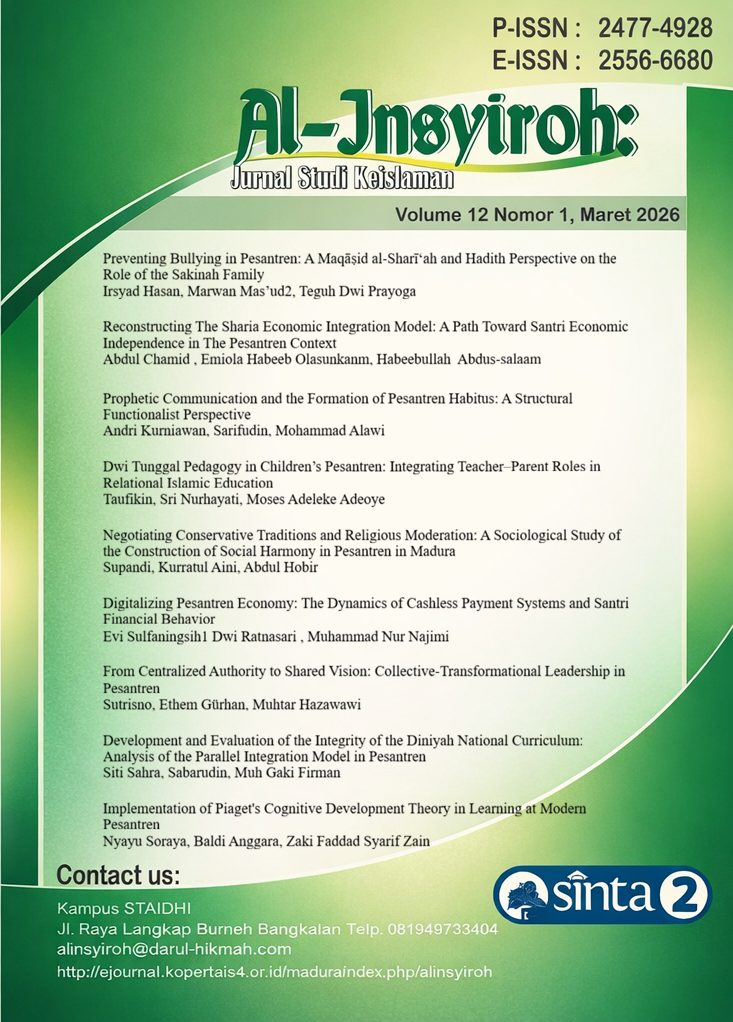
Development and Evaluation of the Integrity of the Diniyah National Curriculum: Analysis of the Parallel Integration Model in Pesantren
DOI:
https://doi.org/10.35309/alinsyiroh.v12i1.649Keywords:
curriculum integration, pesantren, curriculum, Islamic Education, parallel integration model, Quality of LearningAbstract
This study analyzes the development of the integration of the national curriculum and the diniyah curriculum (Islam) and evaluates the quality of its implementation in the Pesantren Alkhairaat in Central Palu. Using a qualitative case study design, data was collected through field observation and in-depth interviews with 4 ustadz and 6 students who were selected purposively. Data analysis was carried out using the interactive model Miles, Huberman, and Saldana, including data condensation, presentation, and conclusion drawing and verification. The results of the study show that curriculum integration develops gradually and is currently implemented through a parallel model, with general learning in the morning and early learning in the afternoon to evening. The effectiveness of the implementation reached around 80%, despite facing limited facilities, tight schedules, and student adaptation to the two curriculum systems. Curriculum integration is still at the structural stage, but it has the potential to lead to substantial integration through strengthening integrative pedagogy, improving teacher competence, and facility support. These findings imply the need for cross-disciplinary teacher training, collaboration in integrated curriculum design, and investment in educational facilities. The research was limited to one case study; The next research is recommended to conduct a comparative study across pesantren to gain a more comprehensive understanding of the curriculum integration model in Indonesia
Downloads
References
Ahmad Budiyono. (2021). The Concept of an Integrated Curriculum. Ilmuna, 3, 1.
Anggraini. (2025). Integration Management of the National Curriculum and Cambridge Curriculum in Improving the Quality of Education. Encyclopedia: Saburai Journal of Learning Education and Innovation, 05(02), 295–307.
Arroisi, J. (2024). Coping the discrepancy between moral and intellectual achievement : the model integration of higher education and modern Islamic boarding schools in Indonesia. Indonesian Journal of Islam and Muslim Societies, 14(2), 231–257. https://doi.org/10.18326/ijims.v14i2.231-257
Astuti et.al. (2023). Optimizing the Role of Islamic Boarding Schools in Islamic Education. Journal of General Studies and Research, 1(3).
Baumfield et.al. (2023). Research characteristics of professional learning across professions: A mapping review. Rewiring Of Education, 11(2). https://doi.org/https://doi.org/10.1002/rev3.3395Pengidentifikasi Digital Objects (DOI)
Bazeley, P. (2024). Conceptualizing Integration in Mixed Methods Research. Journal of Mixed Methods Research, 18(3), 225–234. https://doi.org/10.1177/15586898241253636
Creswell. (2018). Research Design Qualitative, Quantitatif, and Mixed Methods.
Dahal, N. (2025). Qualitative data analysis : reflections , procedures , and some points for consideration. Frontiers InResearchMetrics AndAnalytics, 30(9).
Dimas Assyakurrohim), Dewa Ikhram), Rusdy A Sirodj), M. W. A. (2023). Case Study Methods in Qualitative Research. Journal of Science and Computer Education, March. https://doi.org/10.47709/jpsk.v3i01.1951
Drake, S. M., & Reid, J. L. (2020). 21st Century Competencies in Light of the History of Integrated Curriculum. Frontiers in Education, 5(July), 1–10. https://doi.org/10.3389/feduc.2020.00122
Ergeshov, E. (2025). Legal and Ethical Aspects of Teaching Religion in Schools. Pharos Journal of Theology ISSN, 106(3), 1–14.
Fitriani, A. (2025). A Comprative Analysis Of Contemporary Islamic Education Systems : Philosophical, Sociological, And Pedagogical Perspectives, From Indonesia, Malaysia, And Egypt. Jurnal Studi Keislaman, 11(1).
Hakim, I. R., Unnajjah, L. S., & Rahman, A. S. (2024). Adaptive Strategies of Madrasah in Implementing The National Curriculum and Madrasah Operational Curriculum. Edukasi: The Journal of Educational Research, 04(03).
Hamdani, U. L. (2025). Evaluation of management and curriculum problems for the mutualization of education in salafiyah Islamic boarding schools. Performance: Journal of Islamic Education Management, 3(1), 16–36.
Horwitz, I. M. (2021). Religion and Academic Achievement: A Review of Research Covering High School and College. Journal of Religious Research, 1(3).
Jackson. (2022). An International List of Educational Per¡odicaIs.
Latifah. (2024). The History of Islamic Education in Indonesia. HISTORICAL: Journal of History and Social Sciences, 3(2), 138–153.
Malik et al. (2025). The Challenges of Developing Islamic Education Curriculum and Strategies for Its Development in Facing Future Competency Demands. Tafkir: Interdisciplinary Journal of Islamic Education, 6(1), 111–126.
Malmen, E. P. (2023). Its effects on student argumentative written productions. International Association for Research in L1-Education, 2023, 1–28.
Manaf, S., Darojat, M. H., Hur, M., Zh, R., Zufar, Z., Thaariq, A., Syam, A. R., & Jamil, H. A. (2025). Strategic Integration of General and Religious Education in Indonesian Pesantren : Building Holistic Character for National Resilience . Edcomtech: Journal of Educational Technology Studies, 10(2), 133–146.
Matthew B.Miles, A. Michael Huberman, J. S. (2014). Qaulitative Data Analysis.
Mikko. (2021). Going beyond the boundaries of the curriculum to gain in-depth knowledge. The Curriculum Journal, 32(2). https://doi.org/https://doi.org/10.1002/curj.77
Milerski, B., & Zieliński, T. J. (2023). Religion in a world-view neutral school . Challenges on the example of Poland. British Journal of Religious Education, 45(3), 288–300. https://doi.org/10.1080/01416200.2022.2049208
Mirzat, K. (2025). Teacher Strategies in Character Formation to Enhance Students ’ Social Attitudes at Madrasah. Attadrib: Jurnal Pendidikan Guru Madrasah Ibtidaiyah, 8(3), 598–607.
Muhammad Akhsanul Muhtadin, T. A. L. (2022). Integration of the National Education Curriculum and the Islamic Boarding School Curriculum. Journal of Reform, 11, 2.
Mulyani. (2026). Strategies for the Transformation of Traditional Islamic Boarding Schools in Aceh Singkil : Integrating Education , Social , and Religious Aspects. Tafkir: Interdisciplinary Journal of Islamic Education, 7(1), 80–94.
Mustam, A., Ramli, N., & Zainuddin, M. (2025). Integration-Interconnective : An Implementation of the Unification of Islamic and General Education Policies. Journal of Economics, Finance and Management Studies, 0(04), 2010–2016. https://doi.org/10.47191/jefms/v8
Mustofa, I. (2024). Systematic Review : Meta-Synthesis of Implementation of Act No . 18 of 2019 on Pesantren. Educan Journal of Islamic Education, 8(1). https://doi.org/10.21111/educan.v8i1.11548
Muttaqin, A. I. (2025). Institutional Adaptation of Islamic Boarding Schools in Indonesia : Balancing Tradition and Modern Education. Al-Tanzim: Journal of Islamic Education Management Vol., 09(03), 1016–1029.
Nicholas. (1989). Quality Variations and Maximal Variety Differentiation. Regional Science and Urban Economics, 19, 21–29.
Noer, S. T., Laila, F., Mufarokah, A., Anwar, H. S., & Mudhofar, A. (2025). Curriculum Changes in Indonesia ; Implementation and its Challenges in Religious Institutions. Journal of Education Research and Practice (JERP), 3(1), 1–16. https://doi.org/10.70376/jerp.Received
Qomar, M. (2024). Integration of School Curriculum and Islamic Boarding Schools in Preparing the Golden Generation with holistic intelligence. SHS Web of Conferences, 03001.
Ramos, R. B., & Anonuevo, A. B. (2024). School Heads ’ Experiences on the Conduct of Classroom Observation. Asian Journal of Education and Social Studies Volume, 50(9), 167–186.
Robert K.Yin. (2015). Case Study Research Design and Metode.
Wardi, M. (2025). Evaluation of the Islamic Education Curriculum in Islamic Boarding Schools : Assessing the Impact on the Quality of Learning and Curriculum Management. Journal Evaluation in Education (JEE), 6(2). https://doi.org/10.37251/jee.v6i2.1455
Wingate, T. G., & Bourdage, J. S. (2024). What are interviews for ? A qualitative study of employment interview goals and design. OR IG INA L AR TI CLE What, 555–580. https://doi.org/10.1002/hrm.22215
Wiwi Hadi Sumitro, Abu Anwar, H. (2020). Integration of Religious and Secular Values in Islamic Boarding Schools, Madrasah and Islamic Schools in Indonesia. Journal of Islamic Civilization, 2(2), 98–107.
Wright. (2018). Improving Islamic religious education pedagogy through the application of critical religious education, variation theory, and learning study models. British Journal of Religious Education, 18(7). https://doi.org/https://doi.org/10.1080/01416200.2018.1484695
Yunan, M. (2021). International Journal of Multicultural and Multireligious Understanding Application Values of Character Education in the Modern Pesantren System and Culture ( Study at Pondok Pesantren Modern Ar-Raudlatul Hasanah Medan ). International Journal of Multicultural and Multireligious Understanding, 8(12), 295–307.
Ziyah. (2023). The Influence Of Science Dichotomy On Islamic Religious Education Curriculum. Journal of Learning, Teaching and Educational Studies, 1(1), 7–14.
Downloads
Published
How to Cite
Issue
Section
License
Copyright (c) 2026 Siti Sahra, Sabarudin Sabarudin, Muh Gaki Firman

This work is licensed under a Creative Commons Attribution-ShareAlike 4.0 International License.