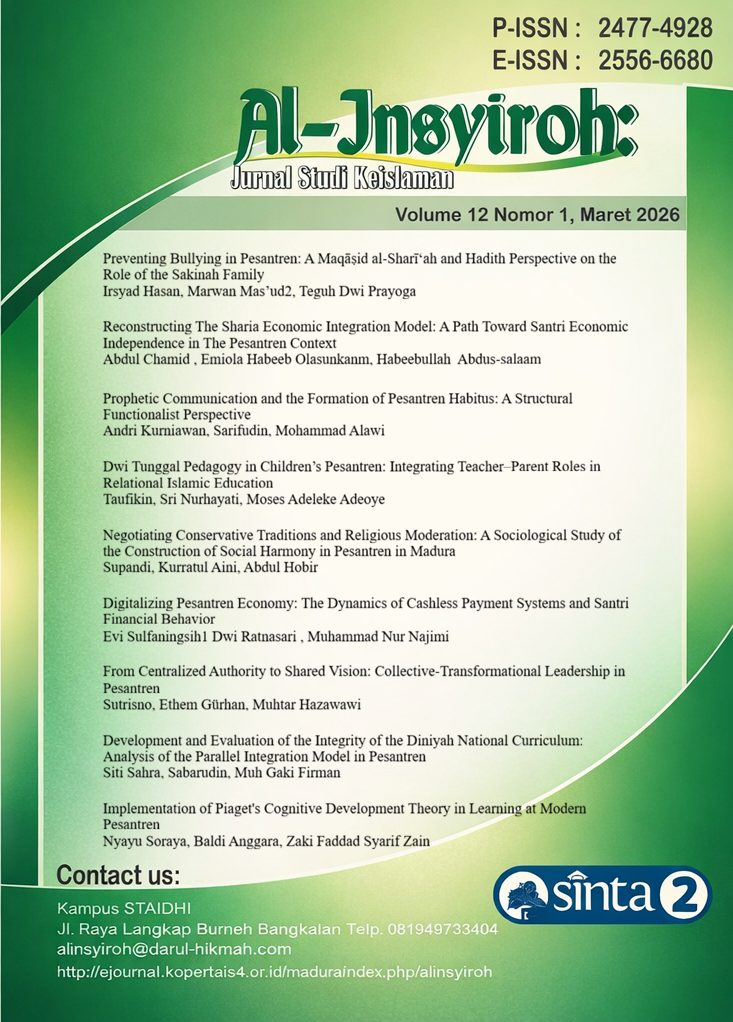
From Centralized Authority to Shared Vision: Collective-Transformational Leadership in Pesantren
DOI:
https://doi.org/10.35309/alinsyiroh.v12i1.680Keywords:
Collective Leadership, Transformational Leadership, Organizational Culture, Faith-Based Education, PesantrenAbstract
The sustainability of faith-based educational organizations often relies heavily on the singular charisma of their founders, making them highly vulnerable to institutional collapse upon the founder's demise ("founder's syndrome"). This study explores the actualization of collective-transformational leadership and its impact on shaping organizational culture within traditional Pesantren. Employing a qualitative multiple-case study design, research was conducted across three distinct institutional models: the Federation, Modern, and pure Traditional models. Data were collected over six months through in-depth interviews with nearly 30 participants—including central clerics, senior teachers, and students—complemented by participant observation and document analysis. The cross-case thematic analysis reveals a strategic structural shift from solitary, founder-centric authority to formalized, shared leadership councils. This transition successfully institutionalizes the clerics' charisma rather than diluting it. Furthermore, through informal communication strategies and spiritual synergy, this collective leadership mitigates internal conflicts and inspires the organizational community. Consequently, this shared authority shapes resilient and agile organizational cultures tailored to specific institutional visions, ranging from socio-environmental activism and global modern integration to the robust preservation of classical scholasticism. Theoretically, this study expands transformational leadership discourse by demonstrating that charismatic influence can operate synergistically as a collective phenomenon. Practically, it offers a sustainable governance blueprint for global faith-based organizations navigating the tension between preserving traditional religious identity and adapting to modern educational complexities
Downloads
References
Arifin, I. (1993). Kepemimpinan Kiai, Kasus Pondok Pesantren Tebuireng. Kalimasahada Press.
Arifin, I., & Slamet, M. (2010). Kepemimpinan Kiai dalam Perubahan manajeman Pondok Pesantren: Kasus Ponpes Tebuireng Jombang. Malang: Aditya Media.
Asror Yusuf, M., & Taufiq, A. (2020). The dynamic views of kiais in response to the government regulations for the development of pesantren. Qudus International Journal of Islamic Studies, 8(1), 1–32. https://doi.org/10.21043/qijis.v8i1.6716
Bakri, M. (2013). Metode Penelitian Kualitatif Tinjauan Teoritis dan Praktis. Surabaya: Lembaga Penelitian Universitas Islam Malang Kerjasama Dengan Visiprees Media.
Bass, B. M., & Riggio, R. E. (2006). Transformational Leadership (Second Edi). Lawrence Erlbaum Associates.
Bizawie, Z. M. (2014). Laskar Ulama Santri & Revolusi Jihad: Garda Depan Menggerakkan Indonesia. Jakarta : Pustaka Kompas.
Bogdan, R. C., & Biklen, S. K. (2007). Qualitative research for education – an introduction to theories and methods (Fifth). Boston: Pearson Education, Inc.
Brigette Lantaeda, S., Lengkong, F. D. J., & Ruru, J. M. (2017). Peran Badan Perencanaan Pembangunan Daerah Dalam Penyusunan Rpjmd Kota Tomohon. Jurnal Administrasi Publik (JAP), 04(048), 243.
Bungin, B. (2012). Analisis Data penelitian Kualitatif. Jakarta: PT Raja Grafindo Persada.
Castro, C. B., Perinan, M. M. V., & Bueno, J. C. C. (2008). Transformational leadership and followers’ attitudes: The mediating role of psychological empowerment. International Journal of Human Resource Management, 19(10), 1842–1863. https://doi.org/10.1080/09585190802324601
Creswell, J. W. . (2014). Penelitian Kualitatif dan Desain Riset, Memilih diantara Lima Pendekatan. Yogyakarta: Pustaka Pelajar.
Danim, S. (2004). Motivasi Kepemimpinan dan efektifitas Kelompok. Jakarta: Rineka Cipta Utama.
Dewantara, K. H. (2013). Ki Hadjar Dewantara: Pemikiran, konsepsi, keteladanan, sikap merdeka (buku I–pendidikan) (M. Tauchid, Soeratman, Sajaga, R. S. Lahade, Sendoro, Abdurchman, & Surjohadidjojo (eds.)). Yogyakarta: Penerbit Universitas Sarjanawiyata Tamansiswa (UST-Press) bekerjasama dengan Majelis Luhur Persatuan Tamansiswa.
Fahruddin, F. (2020). The existence of pesantren in the dutch east indies government pressure. Cendekia: Jurnal Kependidikan Dan Kemasyarakatan, 18(2), 351–365. https://doi.org/10.21154/cendekia.v18i2.1854
Fauzan. (2019). Kepemimpinan Kharismatik Versus Kepemimpinan Visioner. Al-‘Adalah, 2(1), 68–79. https://doi.org/https://doi.org/10.35719/aladalah.v22i1.11
Geertz, G. (1989). Abangan, Santri, Priyayi dalam Masyarakat JawaNo Title. Jakarta : Pustaka Jaya.
Hafidh, Z., Rahyasih, Y., Aminah, A. an, & Gunawan4, M. I. (2022). Reorientasi Kepemimpinan Kiai Di Pondok Pesantren Salafiyyah: Studi Kepemimpinan Di Pondok Pesantren Asy-Syafi’iyyah. Ar-Risalah: Media Keislaman, Pendidikan Dan Hukum Islam, XX(1), 84–97.
Hariyanto, S. (2012). Persepsi Santri Terhadap Perilaku Kepemimpinan Kiai di Pondok Pesantren (Studi Interaksionesme Simbolik di Pondok Pesantren Sidogiri). Jakarta : Kementerian Agama RI.
Hutagaol, K., Saija, L., & Panjaitan, M. M. J. (2020). the Ing Ngarsa Sung Tuladha Cooperative Learning Model and Students’ Problem Solving Abilities. JOHME: Journal of Holistic Mathematics Education, 3(2), 118. https://doi.org/10.19166/johme.v3i2.2005
Idris, U. M. (2013). Pesantren Sebagai Lembaga Pendidikan Islam. Al Hikmah, XIV(1), 101–119.
Isbah, M. F. (2020). Pesantren in the changing indonesian context: History and current developments. Qudus International Journal of Islamic Studies, 8(1), 65–106. https://doi.org/10.21043/QIJIS.V8I1.5629
Jauhari, M. D. (2008). Masa depan Pesantren, Agenda yang belum terselesaikan. Jakarta : TAJ Publishing.
Jauhari, M. I. (2017). Resistensi Pesantren pada Masa Penjajahan Belanda. Kuttab: Jurnal Ilmu Pendidikan Islam.
Kartodidjo, S. (1992). Pengantar Sejarah Indonesia Baru : Sejarah Pergerakan Nasional Dari Kolonialisme sampai nasionalisme. Jakarta : Gramedia.
Larsson, S., & Rönnmark, L. (1996). The concept of charismatic leadership: Its application to an analysis of social movements and a voluntary organization in Sweden. International Journal of Public Sector Management, 9(7), 32–44. https://doi.org/10.1108/09513559610153881
Latif, M. (2018). the Impact of Charismatic Leadership on the Organization. Journal of Islam and Science, 3(2), 204–217.
Latif, Y. (2005). Inteligensia Muslim dan Kuasa. Bandung : Mizan.
Madjid, N. (1997). Bilik-Bilik Pesantren. Paramadina.
Mantja, W. (2003). Etnografi Disain Penelitian Kualitatif dan Manajemen Pendidikan. Malang: Penerbit Wineka Media.
Mardiyah. (2012). Kepemimpinan Kiai Dalam Memelihara Budaya Organisasi. Yogykarta: ADITYA MEDIA Publishing.
Mas’udi, M., Azhari, M., Aziz, H., & Yusuf, S. efendi. (1986). Direktori Pesantren 1. Jakarta: Perhimpunan Pengembangan Pesantren dan Masyarakat (P3M).
Miftahussalam, & Jauhari, M. I. (2021). Inkulkasi Nilai Multikultural pada Santri Pondok Pesantren Al-Hasni Al Latifi Kauman Bondowoso. Kuttab: Jurnal Ilmu Pendidikan Islam.
Miles, M. B., Hubberman, A. M., & Saldana, J. (2014). Qualitative data analysis – a methods sourcebook (3rd ed.). Los Angeles: SAGE Publication Inc.
Misbach. (1996). KH. Imam Zarkasyi Dari Gontor, Merintis Pesantren Modern,. Ponorogo : Gontor Press.
Mudyahardjo, R. (2001). Pengantar Pendidikan. Jakarta: Rajawali.
Muhadjir, N. (2007). Metodologi Keilmuan: Paradigma Kualitatif, Kuantitatif, dan Mixed. Yogyakarta: Rake Sarasin.
Muhith, A. (2017). Kiai ’S Transformational Leadership in Establishing Organizational Culture at Gender Pesantren. Global Journal of Arts, Humanities and Social Sciences Vol.6, 6(1), 20–35.
Najib, A. (2018). Patterns of Islamic Education Moderation in Indonesian History. Didaktika Religia, 6(1), 107–124. https://doi.org/10.30762/didaktika.v6i1.1097
Nasution, S. (2003). Metode penelitian naturalistik kualitatif. Tarsito.
Nisa, A. F., Prasetyo, Z. K., & Istiningsih. (2020). The Teachings of Ki Hadjar Dewantara in Improving the Character of Elementary School Students in the Revolution of Industry 4.0 Era*. 401(Iceri 2019), 49–56. https://doi.org/10.2991/assehr.k.200204.010
Paulsen, N., Maldonado, D., Callan, V. J., & Ayoko, O. (2009). Charismatic leadership, change and innovation in an R&D organization. Journal of Organizational Change Management, 22(5), 511–523. https://doi.org/10.1108/09534810910983479
Richards, J. C., & Schmidt, R. W. (2013). Longman dictionary of language teaching and applied linguistics. Routledge.
Ridwan, A. (2016). Colonial politics of power and cultural identity development of islamic education vis-a-vis european education in the netherland east indies periods. Marâji‘: Jurnal Studi Keislaman, 2(2), 227–247.
Riyanto, Y. (2007). Metodologi penelitian pendidikan kualitatif dan kuantitatif. Surabaya: Unesa university press.
Robbins, S. P., & Hakim, T. A. (2008). Perilaku Organisasi. Jakarta: Salemba Empat.
Royani, A. (2018). Pesantren dalam bingkai sejarah perjuangan kemerdekaan Indonesia. Jurnal Islam Nusantara, 2(1), 121–128. https://doi.org/10.33852/jurnalin.v2i1.75
Rusmini. (2015). Gaya Kepemimpinan Kyai Lukman Al-Karim Dalam Penembangan Lembaga Pendidikan Islam. Analisis: Jurnal Studi Keislaman, 15(2), 497–518.
Saugi, W., Suratman, & Fauziah, K. (2022). Kepemimpinan Kiai Di Pesantren Dalam Meningkatkan Mutu Pendidikan Kiai Leadership in Islamic Boarding Schools in Improving Education Quality. Pusaka Jurnal Khazanah Keagamaan, 10(1), 2022.
Simbolon, P. T. (2007). Menjadi Indonesia. Jakarta : Kompas.
Soekanto, S. (2002). Sosiologi Suatu Pengantar. Jakarta: Rajawali.
Solichin, A. W. (2004). Analisis Kebijakan. Jakarta: Rineka Cipta.
Sulistiyani, A. T., Wibawa, S., Krisnajaya, I. M., & Yuliani, K. (2019). The Neglected Education Contribution Of The Islamic Boarding School (A Case Study Of Kabupaten Hulu Sungai Selatan, South Kalimantan, Indonesia). Jurnal Ilmiah ISLAM FUTURA, 18(2), 250–268.
Suprayogo, I. (2011). Refleksi Pemikiran Menuju Indonesia Baru. Malang: UIN Maliki press.
Susanto.A.B. (2007). Menjadi Supercompany Melalui Budaya Organisasi yang Tangguh dan Futuristik. Jakarta: Quantum.
Wahid, A. (2008). Islam Kosmopolitan, Nilai-nilai Indonesia transformasi kebudayaan. Jakarta : The Wahid Institute.
Wibowo, A. M., & Istiyani, D. (2020). Life skill education on salafiyah islamic boarding school in Indonesia (Learn from pesantren walindo manbaul falah salafiyah ). INCRE, 1–9. https://doi.org/10.4108/eai.11-11-2020.2308305
Yin, R. K. (2013). Case study research: Design and methods (3rd ed.). Thousand Oaks, CA: Sage Publications.
Yin, R. K. (2017). Case study research and applications: Design and methods. Sage publications.
Zarkasyi, I. (1980). Pondok Pesantren Di Indonesia. Ponorogo : Gontor Press.
Downloads
Published
How to Cite
Issue
Section
License
Copyright (c) 2026 Sutrisno Sutrisno, Ethem Gürhan, Muhtar Hazawawi

This work is licensed under a Creative Commons Attribution-ShareAlike 4.0 International License.